 You laughed. It stayed.Te reíste. Se quedó.
Immersive English learning with series on Netflix
It is late, and the episode you were going to watch «just until this one ends» is already the third. A character walks into the kitchen in the dark, opens the fridge, and the light gives him away with his mouth full of cake. Someone switches on the lamp. Without swallowing: «I was hungry.» You laughed out loud, alone, at one in the morning, and months later the line is still there, with its tone and that face, without your ever studying it. That is immersive English learning, even if nobody called it that: what arrives with an emotion stays, and what arrives in a list goes.
The line you remember without meaning to is the clue to how your memory works. And it is the reason why learning English with Netflix series works better than it seems, if you go about it a certain way.
What arrives with emotion stays
Think about where you were when someone gave you big news. You know: the time, the place, even the light in the room. Now try to remember what you had for dinner on Tuesday. Nothing. Both went through the same brain; the difference is that one came with an emotion and the other did not. When something moves you, your brain puts a mark on that memory, and what carries the mark survives.
The mark does not keep everything. It keeps what was in focus at that instant. And in a scene, when someone drops a line and the room falls apart laughing, the focus is the line: the mark lands on it, with the tone and the face that came with it.
Four ways to learn «pool»
Imagine that today you have to learn that «pool» means piscina. There are four ways to do it, and they are nothing alike.
- Repeat it. The usual way: a list with one column in English and one in Spanish, and you chanting «pool, piscina, pool, piscina» ten times. Tomorrow you reach for the word and it is gone. It went through your head without touching anything.
- Picture it. You close your eyes and see it: a blue pool, still, with the sun on it and the edge hot. It is no longer a loose word; it has a picture stuck to it, and a picture is easier to find than a word.
- Step into the scene. You are standing at the edge of that pool, fully dressed, and someone shouts from the water: «Get in the pool!». Now there is a place, a voice and a situation. The word has somewhere to live.
- Live it. You fall into the pool with your clothes on and your phone in your pocket. Or you watch a character in a series fall in at the worst possible moment: the splash, a second of silence, the faces of the others, the roar of laughter. Picture, sound and emotion at the same time. That is not forgotten tomorrow; that stays for years.
A series hands you the fourth without your trying. Nobody asked you to imagine anything: the script put the pool there, the actor took the fall and you supplied the laugh. And the laugh does one more thing: what is funny gets more attention, and we go over it again in our heads without meaning to, on the bus, two days later.
Immersive English learning without leaving the scene
There is one more detail about how we remember: we get back to something more easily when we return to the context we learned it in. The word brings the scene and the scene brings the word. If you learned «pool» with the fall, the next time you hear «pool» you will see the fall, and the next time you see someone fall into the water, «pool» will come to you.
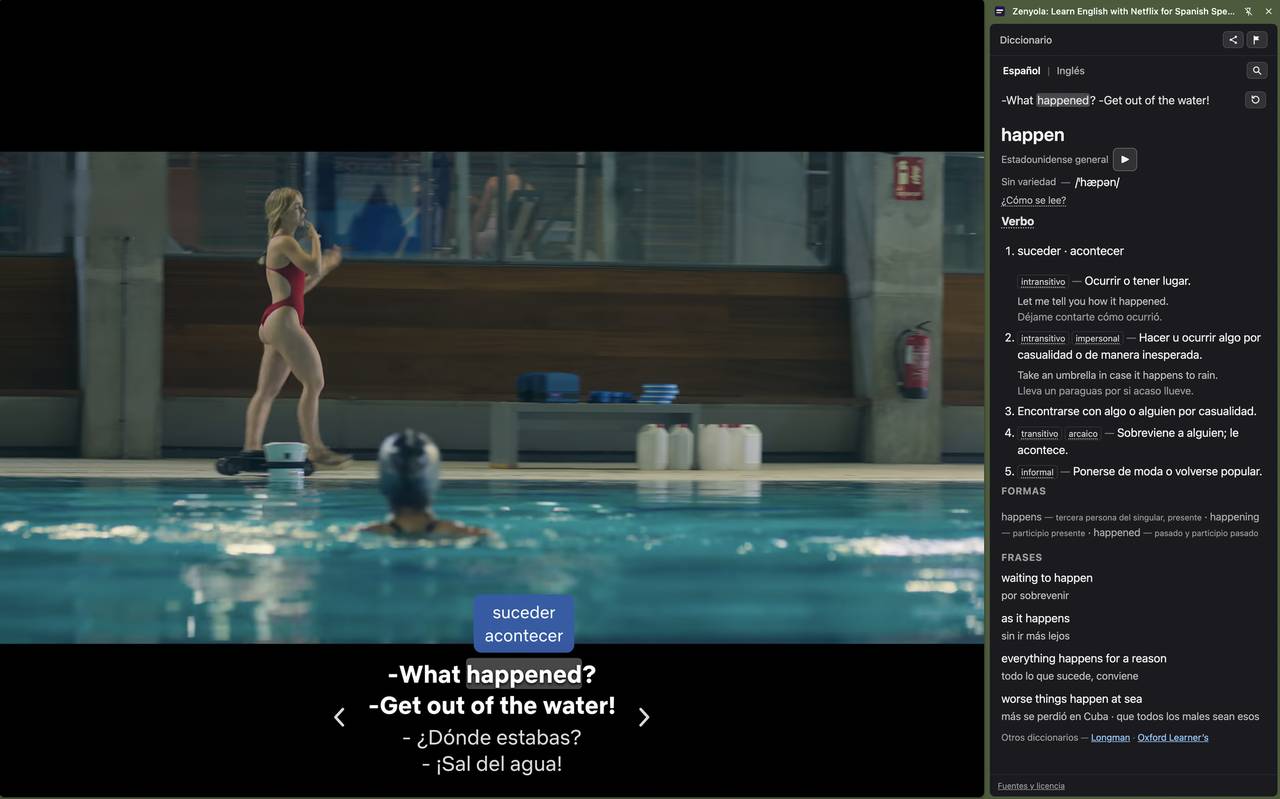
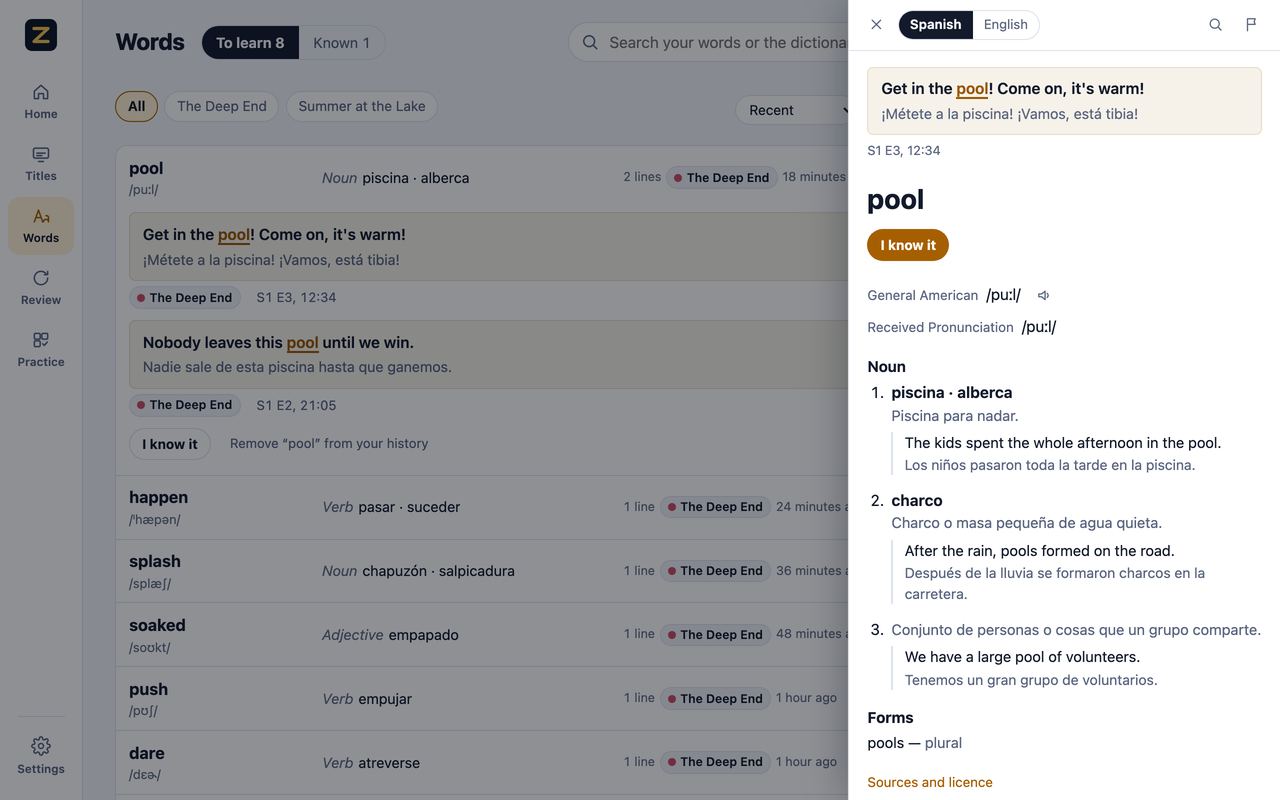
That is what gets lost when you pause, open a dictionary in another tab and come back to a scene you have half forgotten. With Zenyola you look it up without leaving: you tap the word in the English line, its entry opens in a panel beside the video, and the episode pauses while you read, if you chose that. You read the sense it has in that line with the scene still in front of you, and you press play.
Can you learn English by watching series?
Yes, with one condition almost everyone skips: the subtitles have to be in English. Studies have measured it with people at different levels, and the result repeats: when you watch series in English with subtitles in English, comprehension and vocabulary improve, and on the way the ear gets used to a new accent. Subtitles only in Spanish help you follow the plot, but the ear stays outside: you read the story in your language and the English goes by in the background.
That is why in Zenyola the English line goes on top and is the one you read first. The Spanish line sits below, paired with the one above and in time with the video, so you do not lose the thread when a line gets away from you. Both are the ones the series and films you watch on Netflix already carry, written by professional translators. And when you want to listen without a net, you switch the translation line off in the settings and keep the English on its own.
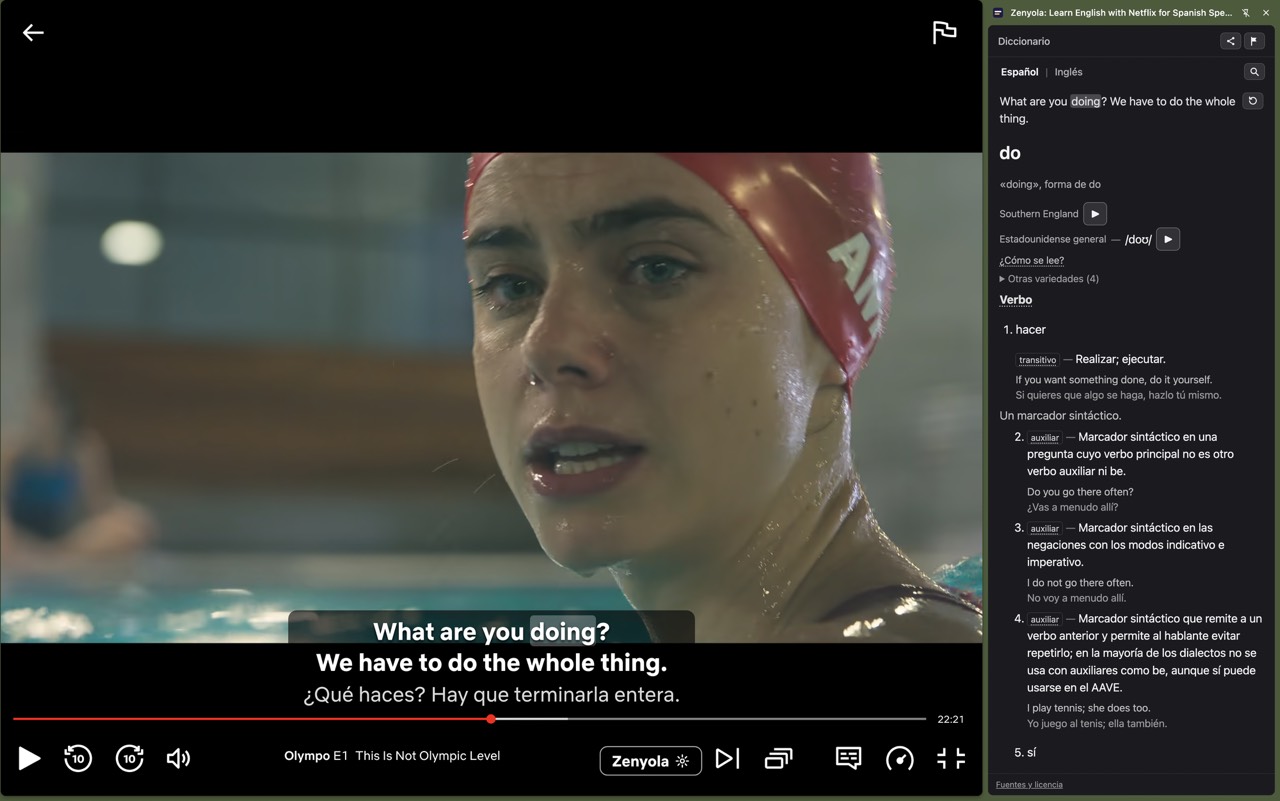
Hearing the line, reading it and seeing the face of whoever says it are three different paths to the same memory. The more paths, the easier it is to get back. With the two lines and the entry beside them you have all three in the same second.
What you tapped is already saved
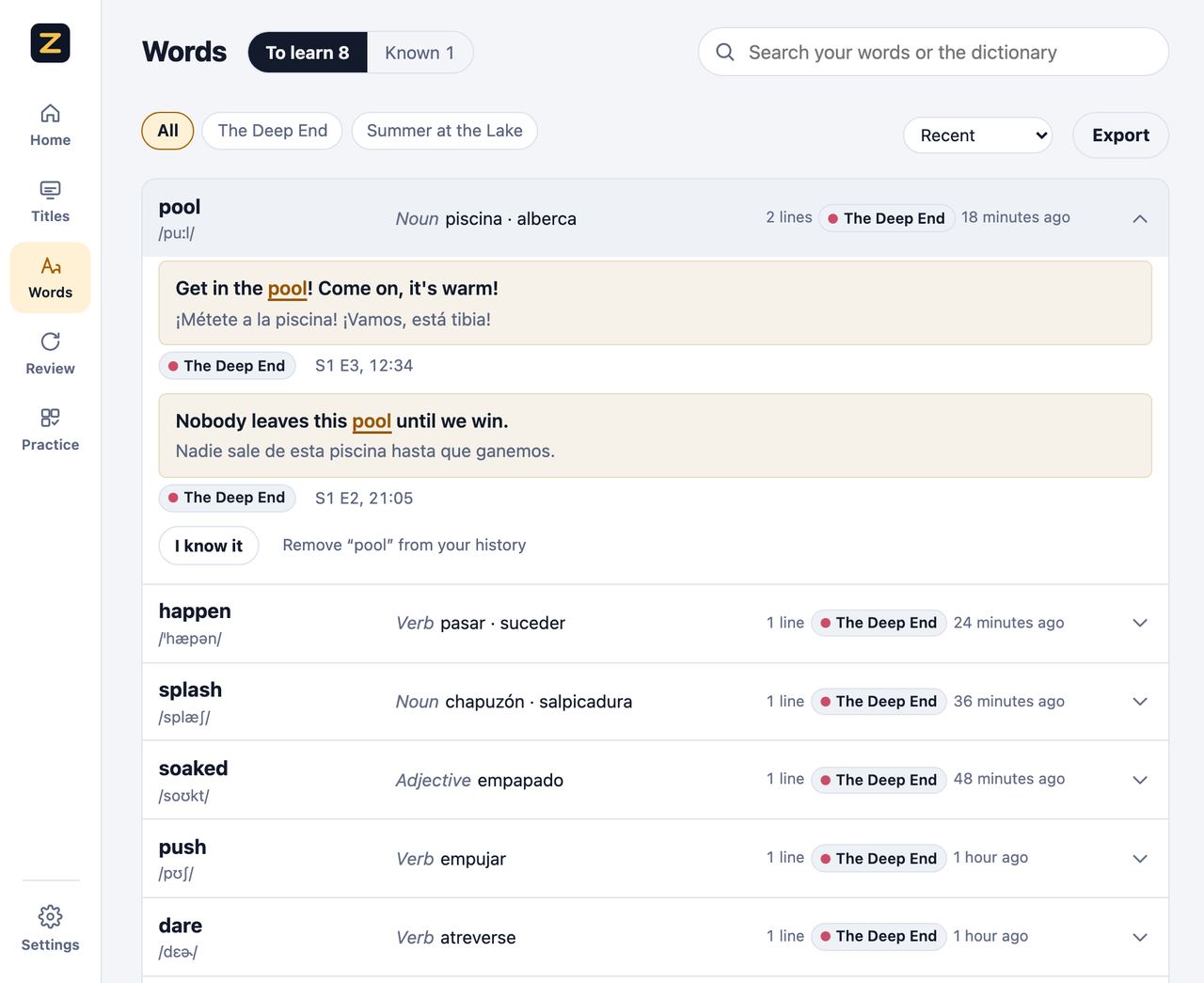
Every word you tap is saved on its own, with the exact line you met it in and the moment of the episode. There is no button to press and no list to keep: the tap you made to understand the line is the record. You decide what to watch; the words you did not know pile up with their scene.
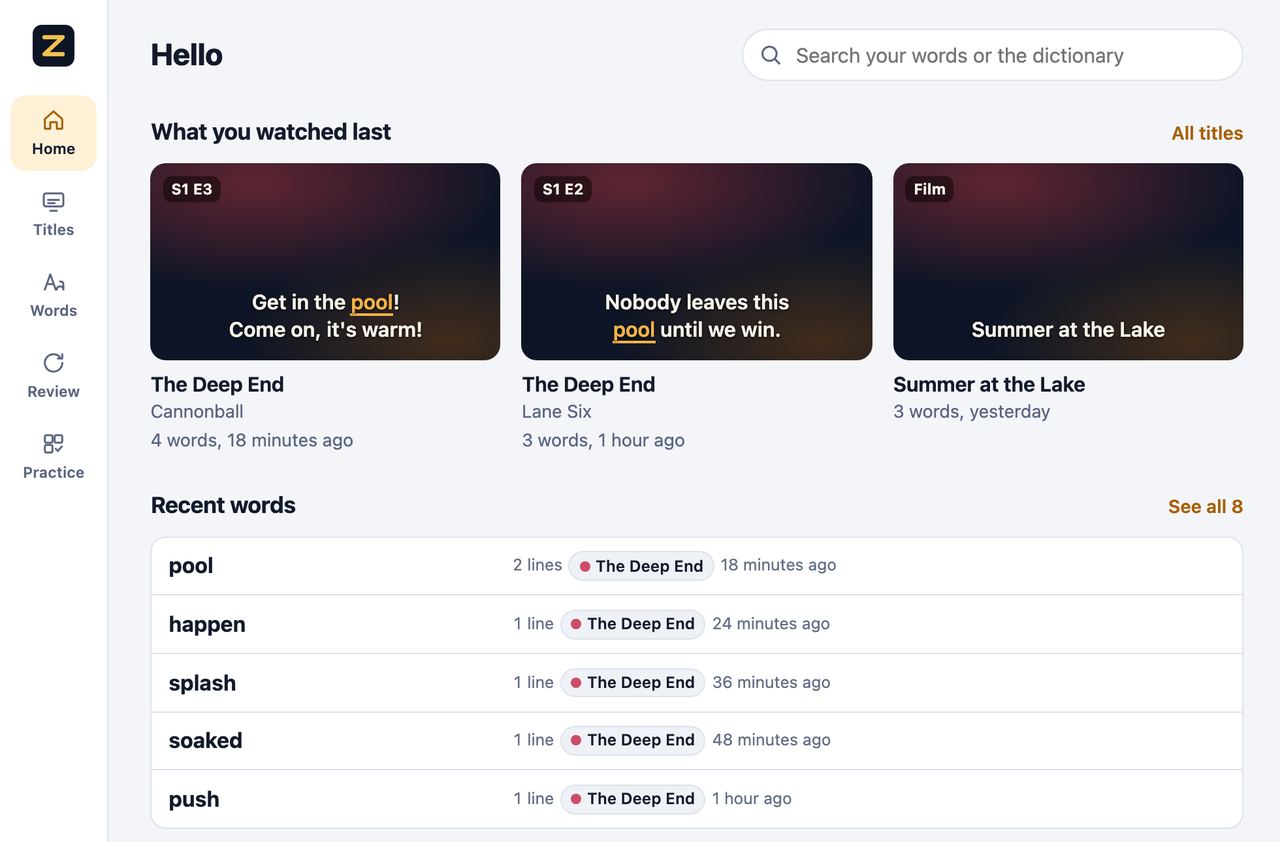
Later, at your own pace, you open the student portal from Zenyola's settings. In Words, each one sits with its line and its translation. And here is a trick worth more than rereading: do not look at the translation yet. Read the English line and try to remember what it meant before looking below. Trying to recall fixes it more than reading it again. If you know it, you mark it «I know it» and it leaves To learn; if you do not want it, you remove it. Your list keeps only what you are really missing.
Immersive English learning starts tonight
It is not a study plan; it is a way of watching what you were going to watch anyway. Pick something that makes you laugh, switch the two lines on and tap what you do not understand. The rest saves itself.
If you want to see what our learning method rests on, here are the studies.
The studies cited
- Cahill, L. and McGaugh, J. L. (1998). Mechanisms of emotional arousal and lasting declarative memory. Trends in Neurosciences, 21(7), 294–299. doi:10.1016/S0166-2236(97)01214-9
- Kensinger, E. A. (2009). Remembering the details: Effects of emotion. Emotion Review, 1(2), 99–113. doi:10.1177/1754073908100432
- Tulving, E. (2002). Episodic memory: From mind to brain. Annual Review of Psychology, 53, 1–25. doi:10.1146/annurev.psych.53.100901.135114
- Smith, S. M. and Vela, E. (2001). Environmental context-dependent memory: A review and meta-analysis. Psychonomic Bulletin & Review, 8(2), 203–220. doi:10.3758/BF03196157
- Schmidt, S. R. (1994). Effects of humor on sentence memory. Journal of Experimental Psychology: Learning, Memory, and Cognition, 20(4), 953–967. doi:10.1037/0278-7393.20.4.953
- Kuppens, A. H. (2010). Incidental foreign language acquisition from media exposure. Learning, Media and Technology, 35(1), 65–85. doi:10.1080/17439880903561876
- Peters, E. and Webb, S. (2018). Incidental vocabulary acquisition through viewing L2 television and factors that affect learning. Studies in Second Language Acquisition, 40(3), 551–577. doi:10.1017/S0272263117000407
- Montero Perez, M., Van Den Noortgate, W. and Desmet, P. (2013). Captioned video for L2 listening and vocabulary learning: A meta-analysis. System, 41(3), 720–739. doi:10.1016/j.system.2013.07.013
- Mitterer, H. and McQueen, J. M. (2009). Foreign subtitles help but native-language subtitles harm foreign speech perception. PLoS ONE, 4(11), e7785. doi:10.1371/journal.pone.0007785
- Paivio, A. (1991). Dual coding theory: Retrospect and current status. Canadian Journal of Psychology, 45(3), 255–287. doi:10.1037/h0084295
- Roediger, H. L. and Karpicke, J. D. (2006). Test-enhanced learning: Taking memory tests improves long-term retention. Psychological Science, 17(3), 249–255. doi:10.1111/j.1467-9280.2006.01693.x
- Open Google Chrome on your computer.
- Add Zenyola from the Chrome Web Store. It is free.
- Play a series or film on Netflix: both lines appear.